
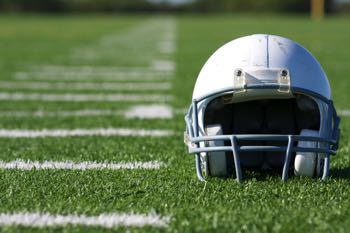
 Elsewhere on this site, there is an argument made that the football might be the most important piece of equipment used in American football. Whilst that could certainly be true, it is also worth pointing out that player safety is paramount to the importance of the game.
With that in mind, there may well be no piece of safety equipment that is more crucial to ensuring the safety of all those involved than the helmet. As you will read here, it began as one thing that looks decidedly laughable by today’s standards, but has grown and developed to become a symbol of the sport itself.
The Original Helmet
.JPG)
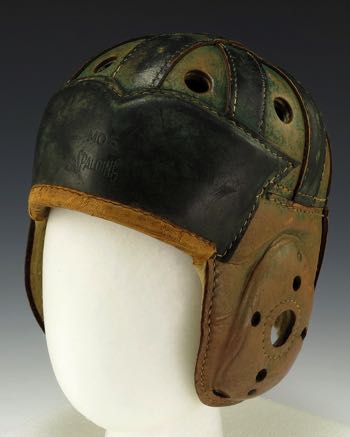
When American football began to take off in the United States of America, the sport was arguably closer to rugby than the sport is today, largely on account of the fact that helmets weren’t worn at all. It took until 1896 before any sort of headgear was worn and even then it was only used by one player. That player was George Barclay, known as ‘Rose’, who played for Lafayette College in Pennsylvania as a halfback. Barclay decided that he wanted to protect his ears, so he wore straps and earpieces that covered them so as to offer at least some scant protection during play.
Who invented the actual helmet, a derivation of which we see in use today, isn’t known. There are numerous sources who believe that its creation was down to James Naismith, the man who invented basketball, but there is no real evidence for that. There are others who believe that it was Joseph M. Reeves, a Midshipman at the US Naval Academy, citing that he wore a protective device made of moleskin that allowed him to play in the Army-Navy game of 1893. Not long after that, helmets began to be made out of padded leather and looked similar to aviator helmets.
The Evolution of the Helmet
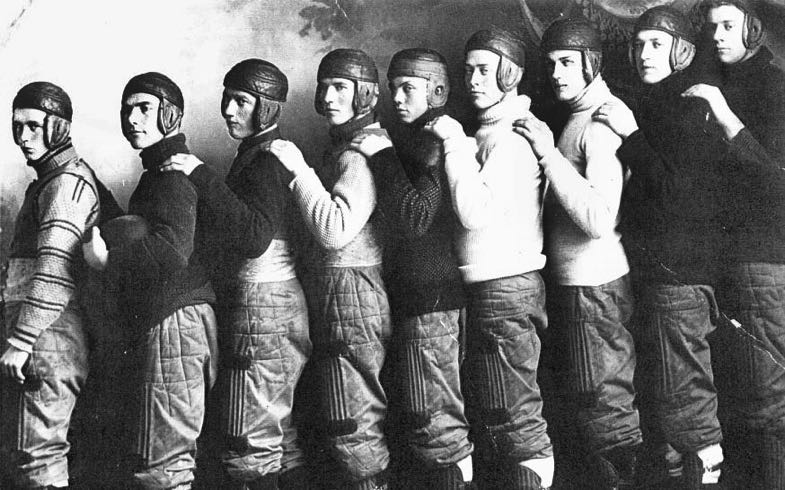

By the turn of the century, helmets began to be made of hardened leather. In 1917, helmets began to be used above the head so as to divert blows away from the top of the head, but it took until the 1920s before they became widely used in the sport. Even then, they actually provided little protection and it took until the 1930s before plastic helmets became commonplace. As well as being more comfortable, plastic helmets also offered more protection. It was in the middle of the 1940s that helmets became a requirement, initially being leather before plastic became the go-to material by 1950.
The fact that plastic became an allowed material for NFL players led to advancements in the technology used in their creation. By the 1950s, for example, polymers had been introduced and leather helmets were all but ended as a result. In 1955, the National Football League began to recommend face masks be used by players, which saw a reduction in the number of broken noses and lost teeth. As a result, rules had to be introduced to ban opposing players from grabbing the face mask when trying to tackle players, with Tommy McDonald becoming the last player to play without a mask.
The Modern Design
.jpg)
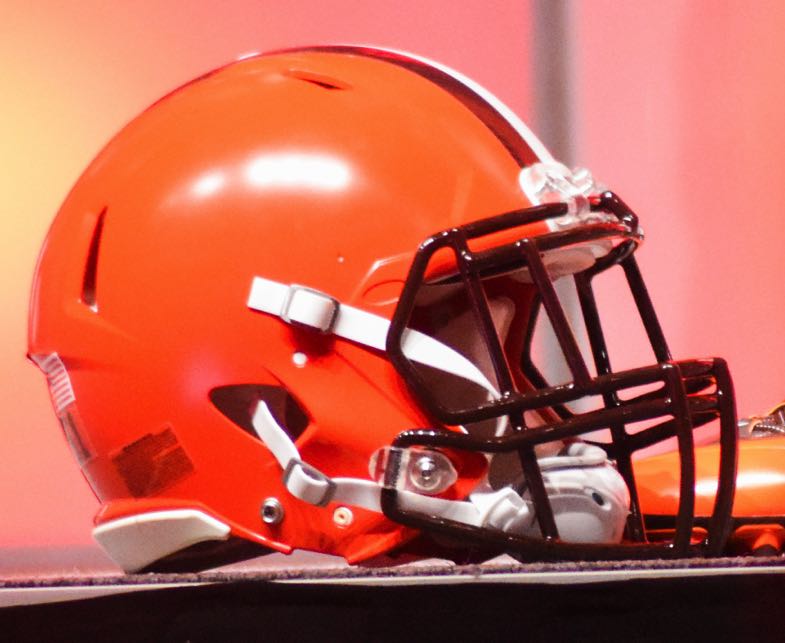
Riddell, the American football equipment maker, released a design of helmet in 2002 that took things in a new direction. It was called the ‘Revolution’ and was designed in response to concerns about concussions, then 12 years later the Riddell Speed Flex came out. This was one that took on aspects of the Revolution and combined them with Side Impact Protection as well as All Points Quick Release face masks for a new-look helmet. Other companies followed suit, with each of the major helmet manufacturers doing what they could to offer protection to players as much as possible.
The modern helmet is made up of an outer shell that uses polycarbonates for solid impact protection, sitting on top of energy-absorbing elements. Unlike something such as a bike helmet, which should be replaced after it’s suffered an impact, football helmets are designed to be able to withstand numerous impacts during the course of a game. More recently, visors have been added to protect the eyes, whilst sensors monitor the level of impacts. The face mask is also important, offering multi-bar protection. Finally, helmets also have the ability to fit in radio headsets for communication with the bench.