


To British sport lovers, the shoes that are worn by footballers will always be known as boots. For Americans, meanwhile, the term used more often than not is ‘cleats’, which is actually a word that means a protrusion from footwear.
Even so, there are definitely some differences between the two types of footwear, so those that want to take part in American football games would do well to ensure that they’re buying the right type of footwear for their matches. They are not the same, even if they could be used interchangeably by players who don’t have much choice of what to wear.
A Brief History of Cleats


There are some suggestions that Roman legionaries wore sandals that had studs on them and offered some slight resemblance to cleats. Known as caligae, they were hobnailed military sandals and were worn throughout the Empire. As sports became more widespread in the 1500s, so did the use of cleats by the people taking part in them. As an example, King Henry VIII had what were reported as ‘football boots’. In the United States of America, it took until 1860 before cleats began to be used, initially as a baseball shoe, with the cleats in place to offer ‘traction’.
In the early 20th century, American football became more and more popular in the US, which is when cleats began to gain more notoriety. Originally the shoes used were essentially the same as those used in baseball, but innovations began to occur in the years that followed. When artificial turf was brought in, for example, different types of footwear were used that boasted short rubber cleats. More changes took place over the following decades, such as what we might think of as studs being replaced with rubber blades, in addition to different cleats for different surface types.
American Football Cleats


It is widely accepted that Joseph Pipal is one of the creators of ‘mud cleats’ that are used in American football. The college football coach came up with the design in order to give players more control as they were running on turf, with Gola manufacturing a version in 1905. By 1920, Valsport had come up with a design and Hummel followed three years after that. Two brothers named Adolf and Rudolf Dassler created a football cleat with replaceable metal studs. After the Second World War, they had a falling out and created two opposing companies, Puma and Adidas.
In 1929, meanwhile, Riddell, one of the best-known American football sports manufacturers, came up with a new look to the clears for the sport. They introduced the notion of ‘action last’, which meant that the sole boasted a steeper angle and therefore a snugger fit. As the years have gone on, cleats have developed further and further, to the point that modern players enjoy wearing moulded cleats that are much more comfortable. The problem is that such cleats don’t allow for different surface types or changes in weather conditions, for example, which is important to play.
What to Look for in Football Cleats
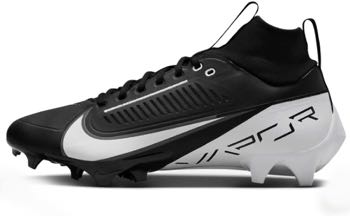 Each type of shoe in the world of sport is built with that specific sport in mind. Football cleats offer stability that allow for sharp turns and sudden moves in a safe manner. Baseball cleats are lighter, on account of not needing to be concerned about impact, while the studs tend to be smaller. Football boots, meanwhile, are built with speed in mind more than anything else. They tend to be much lighter, offering a narrow shape with thick leather on the upper, allowing for repeated contact with the ball. The sole of the shoe also usually has more studs on it than an American football cleat would have.
In American football, the position that you play can have a huge impact on the type of cleat that you will look to use. High-cut cleats are those that linemen would look to wear as they offer support more than speed. Low-cut cleats might be considered by a receiver or cornerback, thanks to the need to make quick movements. Quarterbacks, who look for stability as well as speed, might consider a mid-cut. The surface that a game is being played on will also be important to the type of cleat used, whilst the style of them as well as their colour will be a matter of personal choice.