
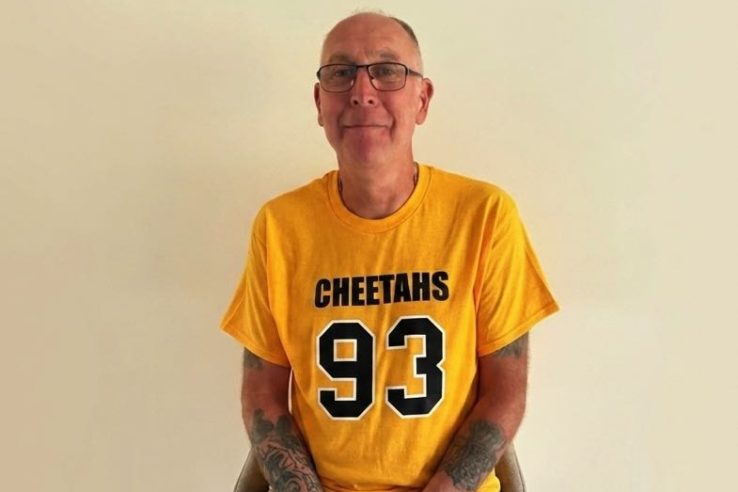
AmericanFootball.org.uk are delighted to present an exclusive interview with Alan Porter, a former British American football player and author of The Weekend Warrior.
As a former Chiltern Cheetah, now known as the Hertfordshire Cheetahs, based in Watford, we got in touch with Alan to ask him how he got involved with American football in the first place, the memorable moments he experienced on the pitch, as well as his advice for anyone hoping to get involved in playing American football here in the UK at a competitive level.
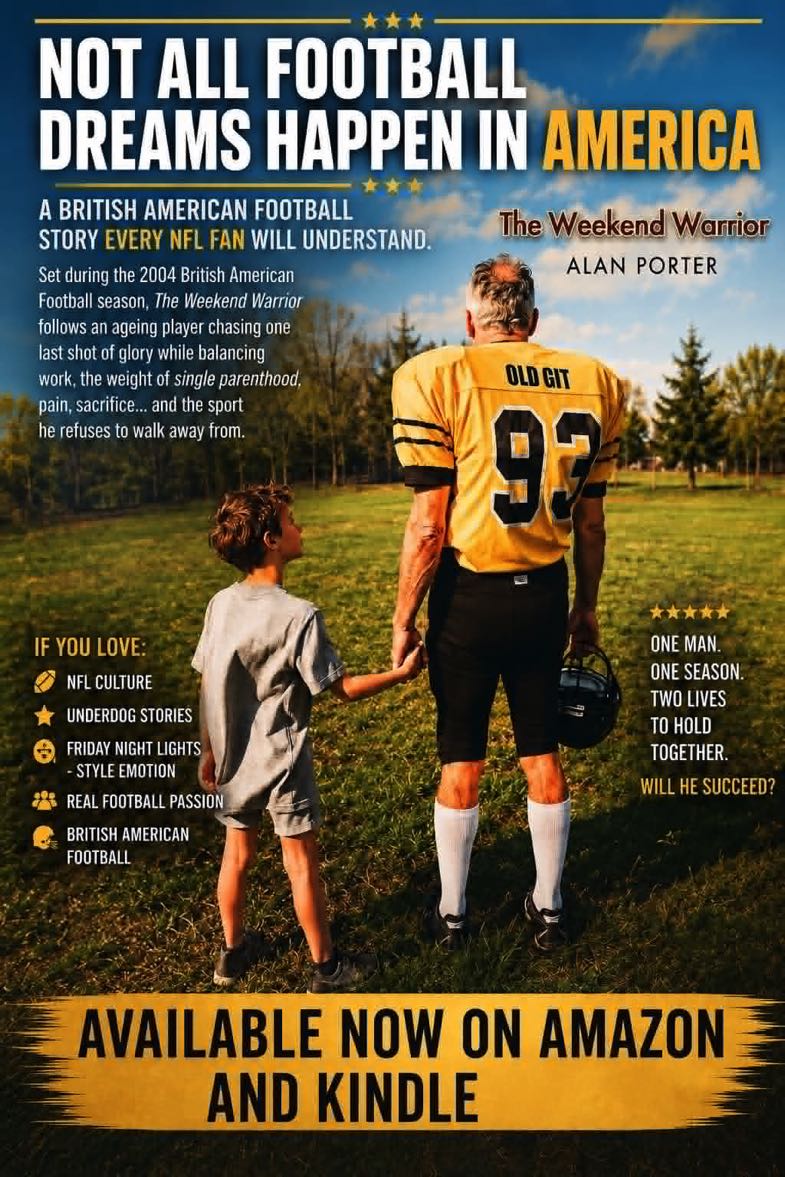
Alan also tells us what inspired him to write his book, The Weekend Warrior, which follows his time as an ageing British American football player who is trying to balance work with parenthood and the sport he pours his heart into.
How did you get into American football in the UK?
Alan: My dad, who watched every sport going on TV, stumbled across the new Channel 4 showing NFL highlights with Nicky Horne in the autumn of 1982. It aired at 7pm and was competing against Last of the Summer Wine or Songs of Praise, so it became an instant hit with him and me. I even cut short band practice to make it home in time to watch. I was hooked. Took me a while to master the rules but by Christmas both Dad and I had got it. I was 18.
What position did you play, and what was the hardest part of mastering that role?
Alan: Initially, I was plonked in at Defensive Tackle, which was silly given that I was barely 12 stone but being 6ft 2” made you a lineman in those days. That was at the F14 Tomcats in the Capital League. I left them when I moved house and joined the Chiltern Cheetahs, again as a DT, but they soon moved me to DE (defensive end). I wanted to be a LB (linebacker) but the Cheetahs had enough of them at the time, although eventually I did get to be an OLB (outside linebacker).
The hardest part of playing the role was being strong enough to defeat double teams. I was never strong enough (despite hours in the gym and bucketfuls of crash weight gain I never weighed more than 13st 2lb when playing) so I had to rely on speed, technique and determination to get to the QB (quarterback).
How did you balance your training and game schedule with work and family life?
Alan: Well, there were times when I didn’t. As my book details, I tried to fit everything in, but ultimately ended up doing none of the things very well. I would try to fit it around my shifts as a printer but I don’t think I ever reached the level of fitness I was capable of. Four kids, a mortgage, a house in constant need of updating and football; it was a constant juggling act.
Which NFL player do you watch or model your game after the most?
Alan: I wanted to be Howie Long (I’m a lifelong Raiders fan) but I knew I was never going to be that big, so I followed Greg Townsend. I chose his number, #93, as mine when at the Cheetahs. I watched his moves, his stances and how he conducted himself. The most important thing I learnt was to never give up on the play until it is whistled dead. loved that Raider defense. Matt Millen, Shaun Jones, Mike Haynes, Lester Hayes, Rod Martin, Bill Pickel, Van McIlroy, Mike Davis, Jack Squirek, all of them.
How would you describe the standard of competition and team culture on the Chiltern Cheetahs?
Alan: In hindsight, our standard was low. Chiltern Cheetahs mostly competed at the lowest level in the UK. That is not to say that we did not train and play hard, and as a defense, we prided ourselves on hitting the opposing team hard and often. When I played in the late 80’s and early 90’s, the team was run by a small group of senior players as none of us took very kindly to coaches!
The culture was great. We all pulled together and in 1993 nearly went all the way. I retired in 1994, only to come back in 2001, when there was a coach but the culture remained the same. We all pulled together. When you are playing in a game, your team mates are your brothers and you are always prepared to put your body on the line for them. When practicing, you might have the odd squabble but that disappears come game time.
I loved being a Cheetah. A great bunch of guys, the team of that era. Dave Guest, Digger, Roger Crawley, Dave Farmbrough, Steve Hicks, Mack, Paul Stinson, Pete Dixon, Pat O’Rielly, Warren Bolton, Paul Brown, Bob Williams and Paul & Stuart Fildew to name but a few. I still miss being around those guys and I always will.
When I came back to play in 2001 as the old man of the team it was just the same but everyone was younger. Conrad Patrick, Nick Mick, Strub, Ratty, Khalid, Giles Stevenson, Owen, Darren and Spencer Whybrow to name a few more. With both teams we had losing seasons before improving to be division winners.
There is nothing better than being part of an organisation that struggles through hardship to finally win something. You build and bond. Although the big one always eluded us. I still miss the camaraderie, the humour and the shared hardship.
Tell us about favourite memory or toughest match during your time playing with the Chiltern Cheetahs.
Alan: My toughest match was away at London Barbarians. Nobody wanted to go as they had a fearsome reputation, having allegedly put refs in hospital and beat up opposing teams. We had already lost to them at home 34 – 10 and that 10pts had been all they had conceded so far, so they were furious with us.
Only 19 of us turned up to play and on a boiling hot afternoon in August we got smashed. I tore both my left knee and shoulder that day, playing both DE and G (guard) for the offense. Our best DT played QB and our star LB played RB (running back) as well. Predictably, we got stuffed 78 – 0! Later in the season the Barbarians were banned and thrown out of the league, so the result was scrubbed but I still remember.
One of my favourite games was in my last season in 2004 when we played Sussex Thunder away. We needed to beat them to secure the division title as they were our closest rivals. I actually did not play much as our Defensive Coach and I were not seeing eye to eye but that didn’t matter. I got to watch our offense conduct a masterful drive which ended with Conrad Patrick making a endzone reception to win the game.
All season I had been rooting for Conrad to be used more as no Chiltern Cheetahs team I played on ever had a decent passing game. Indeed , during the game I had been hassling the coaches to throw Conrad the ball, hence why I was on the bench, so It was a joy to watch a talented player finally get the plaudits he deserved. I was the first one in the endzone to congratulate him!
What are the biggest challenges of playing American football at the competitive level in the UK compared to what we see on TV from the NFL?
Alan: From my perspective, the biggest challenge is funding, closely followed by time. The Chiltern Cheetahs in my era had to pay to play, buying their own equipment, game shirts, etc and paying subs to enable things like tackle dummies to be bought and pitches to be rented and maintained.
Time is always a problem, as pretty much all players at the lower levels have to work to pay rents or mortgages and support families. This does not give much time for training, whether that be on fitness or team tactics. Nothing is given to you in the UK. In the US, everything is provided, even down to Peewee level.
What is one piece of advice you’d give to someone in the UK wanting to get into playing American football?
Alan: Make sure you are fit enough before you engage in full contact. In my time, I have seen so many players get injured on the practice field due to not being fit enough. If the team you join is well organised, with a decent Head Coach, then they should not put you into contact until you are ready. Like many others in my day, I was thrown straight in and paid the consequences. I’m still paying now, having had my left knee replaced in January.
Check the team out, talk to current players, go to watch the practices before committing. But once you do commit, don’t be half hearted. Put your all into it. And enjoy the contact! It was always a pleasure knocking heads with my team mates.
Tell us about your book The Weekend Warrior and what inspired you to write it.
Alan: I started writing it during my last season in 2004. I was about to get made redundant (I’m telling you the plot) so I had time. The book never got finished as life got rather hectic until Covid hit in 2020. I was recovering from surgery on my left lung to remove a cancer that had spread and was not allowed back to work, so I took that opportunity to finish the book, because if I hadn’t done it then it would never have got done.
I was inspired by the derogatory remarks constantly being made about our sport in some quarters. Most people do not know that it is played over here, that there is a league and there are clubs up and down the country. I know there is a market for a book about our sport in the UK, so I persevered. The London games are always sold out. Thousands of people play the game across the nation. Millions have played Madden on the Xbox, so the excuse all publishers have given is that ‘it is not popular enough’ does hold up. So, I went ahead and published myself.
It is about my last season in 2004. It starts with a flashback to 1993 and a loss in a playoff game and then follows the 2004 season to its’ conclusion. It details a pivotal ten months of my life as I battle as a single parent with four kids to hold everything together as everything seems to fall apart around me. There is family life, work life and football life, because to tell the story properly I could not ignore the non-football aspect as that has a strong bearing on how you train and play.
I think it will resonate with anyone who plays, or has played the game. We all endure the ups and downs of life and other people probably have better stories to relate than mine, but I believe this is the first memoir written exclusively about our sport in the UK from a players perspective, and for that I am rather proud. I just want to bring it to a greater audience if I can.
You can learn more about Alan’s story as a British American Football player in the UK by purchasing his book, The Weekend Warrior, on Amazon.